
Where to Sell Sports Cards in 2026: eBay, Whatnot, Mercari, Auction Houses and Card Shops
eBay, Whatnot, Mercari, Facebook Marketplace, consignment auction houses, card shops and card shows compared on fees and buyers, plus when grading a card pays off.



- Most sellers: eBay is the main market for sports cards, raw or graded. Sports trading cards carry a 13.25% fee in the US, and cards of $200 or more go through eBay’s free Authenticity Guarantee check.
- Live selling: Whatnot suits breakers and sellers who will stream auctions.
- Cheap and mid-value cards: Mercari (10% fee) and Facebook Marketplace work as extra outlets for lots, team sets and local sales.
- High-value graded cards: collectibles marketplaces and auction houses such as Fanatics Collect and Goldin are worth comparing with eBay.
- Raw or graded: grade rookies, autographs and numbered parallels in top condition. Sell base cards and most modern cards raw.
There is no single best place to sell sports cards. A $3 base card, a box of 1990s commons and a graded rookie autograph each belong somewhere different. This guide compares eBay, Whatnot, Mercari, Facebook Marketplace, consignment auction houses, card shops and card shows on fees and buyers, then works through the raw-or-graded decision that sets most of a card’s price. It’s written for US sellers, with a short section for the UK.
What Is the Best Place to Sell Sports Cards?
For most people it’s eBay. It has the most buyers, its sold listings are what collectors use to price cards, and it handles both raw and graded cards at every price. The other options earn their place for particular stock: Whatnot for live auctions and breaks, Mercari and Facebook Marketplace for cheaper cards and lots, auction houses for high-end slabs, and shops or shows when you want cash today.
| Where to sell | Seller fee | Best for | Speed of sale |
|---|---|---|---|
| eBay | 13.25% up to $7,500 plus $0.30 or $0.40 per order (US) | Almost everything: singles, slabs, lots | Days to weeks |
| Whatnot | Commission plus processing per sale | Live auctions, breaks, sealed boxes | During a show |
| Mercari | 10% of item price and buyer-paid postage | Mid-value singles, team lots | Days to weeks |
| Facebook Marketplace | A fee on shipped orders where offered | Whole collections, local buyers | Varies |
| Fanatics Collect | No seller fee on graded auction sales. 6% on Buy Now listings priced below 120% of market value | Graded and authenticated cards | Weekly auctions or Buy Now |
| Goldin and other auction houses | Set by the auction house | Rare and high-value cards | Weeks, tied to auction dates |
| Card shop or card show | No fee, but a lower price | Bulk and quick cash | Same day |
How Much Does eBay Charge to Sell Sports Cards?
On eBay US, sports trading cards sit in a lower fee band than most categories. eBay charges 13.25% of the total sale up to $7,500 per item, then 2.35% on anything above $7,500. A per-order fee of $0.30 applies to orders of $10 or less, and $0.40 to larger ones. The total sale includes the postage and sales tax the buyer pays, so the fee comes out slightly higher than the card price suggests.
Here’s what that looks like on a $120 rookie card with free shipping, counting the card price only: 13.25% is $15.90, plus $0.40, so you keep $103.70 before postage and supplies. On a $4,000 slab the fee is $530.40, which is why sellers of very expensive cards often compare eBay with an auction house.
eBay’s Authenticity Guarantee covers single sports cards sold for $200 or more, raw or graded, at no charge. After the sale you post the card to eBay’s authentication facility, where PSA checks that it matches the listing before it goes on to the buyer. Nothing is graded or regraded at this stage. Graded cards only qualify in slabs from PSA, SGC, BGS (Beckett), CGC Cards or CSG. Lots, sets, boxes and packs don’t qualify, and the card must be listed in the right category. For a seller, the check adds a few days but removes most “this isn’t the card I ordered” disputes on expensive cards.
What Is the PSA Vault on eBay?
The PSA Vault is eBay’s official vault for trading cards, run by PSA. Cards are stored and insured there, and you can sell them on eBay without posting anything yourself: PSA handles the listing, packing and shipping. A buyer of a raw card of $200 or more on eBay can choose to have it graded by PSA and sent straight into the vault.
For sellers, the vault suits collectors who buy and sell the same high-value cards repeatedly, since a card can change hands without being posted each time. Selling through PSA on eBay carries consignment rates, which PSA publishes separately, so check them against selling the card yourself. If your buyer chooses to send a card to the vault, you post it to the Authenticity Guarantee facility first, as with any other card over the threshold.
Is Whatnot Good for Selling Sports Cards?
Whatnot is the main live-selling app for sports cards. Buyers join a seller’s stream, watch breaks and bid against each other in real time, which can push a hot player’s card above its fixed-price value. It rewards sellers who show up on camera regularly and build a following. If you only want to clear a few dozen cards, fixed-price listings elsewhere are less work. Our guide to selling sports cards on Whatnot covers its fees, break formats, grading for Whatnot buyers and how to price auctions.
Should You Sell Sports Cards on Mercari or Facebook Marketplace?
Both work best as second outlets for stock you’re already selling on eBay. Mercari US charges a 10% selling fee on the item price plus any postage the buyer pays, with no separate payment processing fee. On a $40 card with free shipping, that’s $4. Buyers on Mercari send a lot of offers, so price with some room.
Facebook Marketplace is where collections change hands locally. A buyer can look through a box of cards in person, which matters for lots that are hard to photograph card by card. Shipped checkout is only offered in some places and carries a fee. Meet somewhere public, bring a card scanner app or price guide if you’re unsure of values, and don’t hand over expensive cards before you’ve counted the cash. Card-collecting Facebook groups are another route, but they rely on the buyer’s and seller’s reputation within the group rather than any marketplace protection.
When Should You Consign to an Auction House?
Consignment makes sense for graded cards worth hundreds or thousands of dollars, where a specialist audience can add more to the price than the fee takes away. You send the card in, the auction house photographs and lists it, and you’re paid after the sale.
Fanatics Collect says sellers pay no fee on graded collectibles sold in its Weekly and Premier Auctions, and that auction sales earn a bonus commission on top of the hammer price. Its Buy Now marketplace charges a 6% seller fee on cards listed below 120% of the market value shown by Card Ladder, and a higher fee above that. Goldin and other auction houses set their own terms and timings for each consignment, so get them in writing and compare the payout with an eBay sale at the same price before you send anything.
The trade-off is time and control. Your card waits for an auction slot, and you usually can’t pull it once it’s live. For a $50 card, none of this is worth it.
Should You Sell Sports Cards Raw or Graded?
Sell raw unless the card is valuable, in excellent condition and the kind of card buyers expect to see slabbed. That usually means rookie cards of star players, autographs, low serial-numbered parallels and vintage cards. Base cards and most modern inserts sell for too little to cover a grading fee.
Look closely before you decide. Graders score centring, corners, edges and surface. A card that looks perfect in the hand can have a print line, a soft corner or off-centre borders that cap it at a mid grade, and a mid-grade slab of a modern card can sell for less than the raw card did.
The main graders for sports cards are PSA, SGC, BGS (Beckett) and CGC Cards. All four are accepted for eBay’s Authenticity Guarantee. CGC’s current US rate is $17 a card on its Bulk tier and $20 on Economy. Insured postage both ways and the wait on the cheaper tiers come on top.
A worked example shows how quickly the margin goes. Say a raw rookie sells for $60 and a high grade of the same card sells for $150. After a $17 grading fee and around $15 of postage and insurance, the high grade leaves you about $58 better off. If it comes back a grade lower and sells for $70, you’ve spent $32 to make $10. Check eBay sold prices for each likely grade before you send anything. Our Pokémon card guide covers grading for trading card games, where the maths is similar.
Are Card Shops and Card Shows Worth It?
They’re the fastest way to turn cards into cash. A local card shop will make an offer on the spot, and a card show puts dozens of dealers in one room, so you can collect several offers on the same card in an afternoon. Expect offers well below eBay sold prices, because the dealer has to resell at a profit. Shows are also a good place to buy, trade and learn what dealers are paying for, which helps you price what you sell online.
Shops and dealers are a good home for bulk: thousands of base cards and commons that aren’t worth listing one at a time. Many shops offer more in store credit than in cash.
How Do You Sell a Whole Sports Card Collection?
Sort it before you sell it. Pull out rookies, autographs, memorabilia cards and anything serial-numbered, then check those individually against sold prices. Group the rest by team, player or year. Team lots and player lots sell better than an unsorted box, because buyers are usually collecting something specific.
Then match each pile to an outlet: the best singles to eBay, possibly graded; mid-value cards and team lots to eBay and Mercari; the leftover bulk to a shop, a show dealer or a single Facebook Marketplace listing. Inherited collections from the 1980s and early 1990s often contain a lot of cards that were printed in huge numbers, so a few key cards may hold most of the value.
Where Do You Sell Sports Cards in the UK and Europe?
The UK market is much smaller. eBay UK is the main outlet, and private sellers there pay no final value fee on most items, cards included. Whatnot also runs shows in the UK. Facebook groups and local card shops fill the same role as in the US.
Outside the UK, local classifieds sites take sports cards alongside other second-hand goods: Kleinanzeigen in Germany, Marktplaats in the Netherlands, leboncoin in France and Wallapop in Spain, Italy and Portugal. Kleinanzeigen is free for private sellers up to 100 listings in 30 days.
Can You List the Same Card on Several Marketplaces?
Yes. A card listed on eBay, Mercari and Whatnot reaches three groups of buyers. The catch is that each card exists once. If it sells on Mercari while still live on eBay, a second buyer can pay for it, and cancelling that order hurts your seller standing.
FLUF Connect is a crosslisting app built to handle that. You create a listing once and send it to the marketplaces you sell on, out of 100+ that FLUF supports. When the card sells on eBay, Whatnot, Mercari or Facebook Marketplace, FLUF picks up the sale and takes the card off the others. eBay connects directly. Whatnot, Mercari and Facebook Marketplace connect through the FLUF browser extension or the FLUF Mobile app.
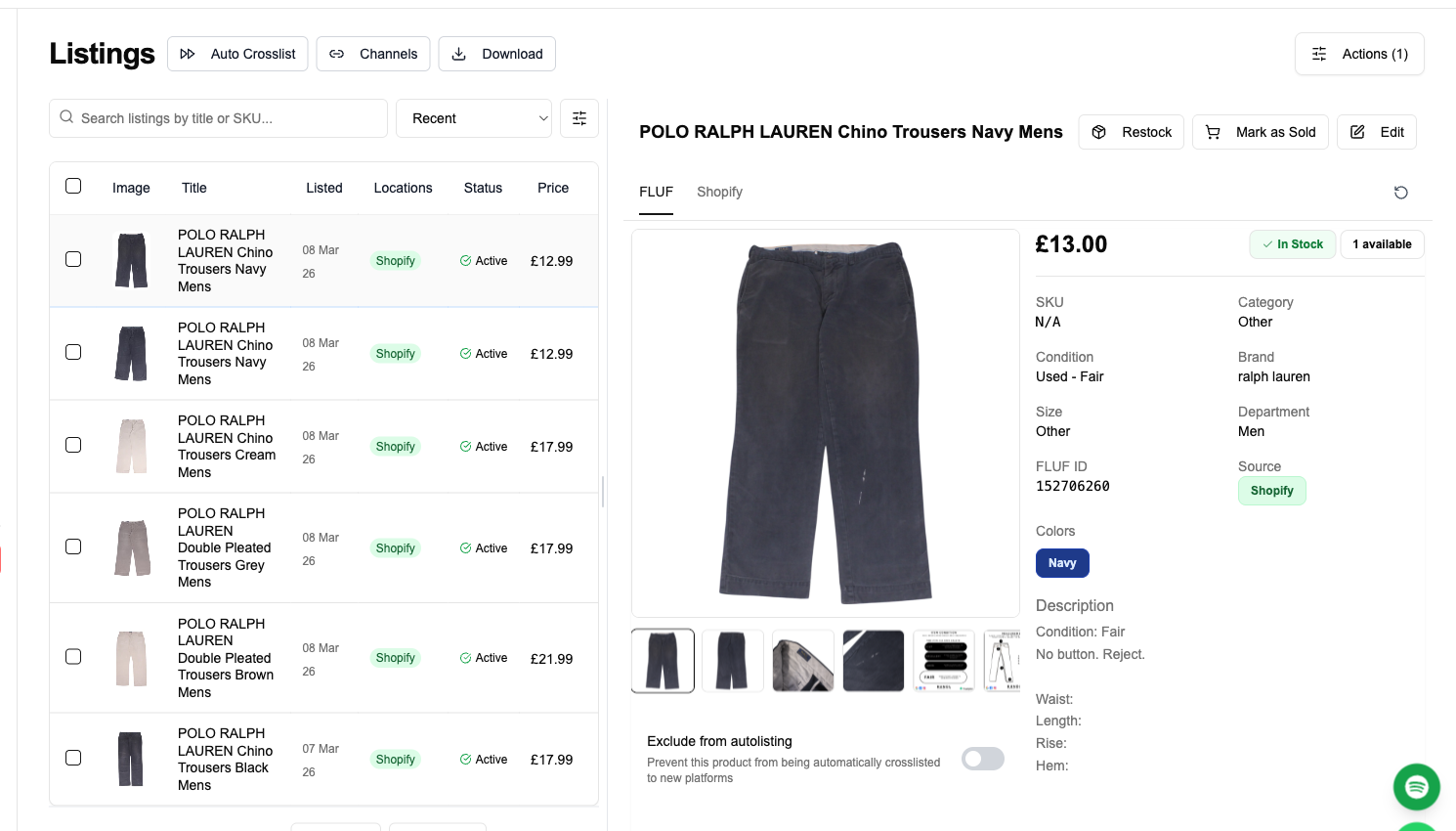
FLUF Connect doesn’t grade, authenticate or price cards. Fanatics Collect, Goldin and other auction houses aren’t connected to FLUF, so consign high-end cards with them directly and keep them off your crosslisted stock.
List your cards once, sell them wherever collectors buy
7 days for £1, then from £9/month.
For more on the software side of reselling, see reseller apps and our crosslisting app comparison.
eBay’s own results on trading cards and collectibles are summarised in what sells on eBay.
Sources & Verification
Last verified: 2026-11-09. Please contact us if any figure is out of date.
Frequently Asked Questions
Rookie cards of star players, autographs, memorabilia cards, low serial-numbered parallels and vintage cards in good condition. Check eBay sold prices for each one. Base cards and commons usually sell better as team or player lots, or in bulk to a card shop.
Yes, for single sports cards sold for $200 or more in the US, at no charge to buyer or seller. The seller posts the card to an authentication facility, where PSA checks it matches the listing. Graded cards qualify only in slabs from PSA, SGC, BGS, CGC Cards or CSG.
CGC charges $17 a card on its US Bulk tier and $20 on Economy. Insured postage both ways comes on top, and the cheaper tiers take longer. PSA, SGC and Beckett set their own prices, so compare them on their sites before you submit.
eBay has more card buyers and is the default for graded and high-value cards. Mercari charges a flat 10% with no processing fee and suits mid-value singles and lots. Many sellers list the same cards on both and remove them from one when they sell on the other.
Yes. You create the listing once and FLUF Connect sends it to eBay, Whatnot, Mercari, Facebook Marketplace and other marketplaces you choose. When the card sells on one of those four, FLUF takes it off the others. It doesn't grade, authenticate or price cards.